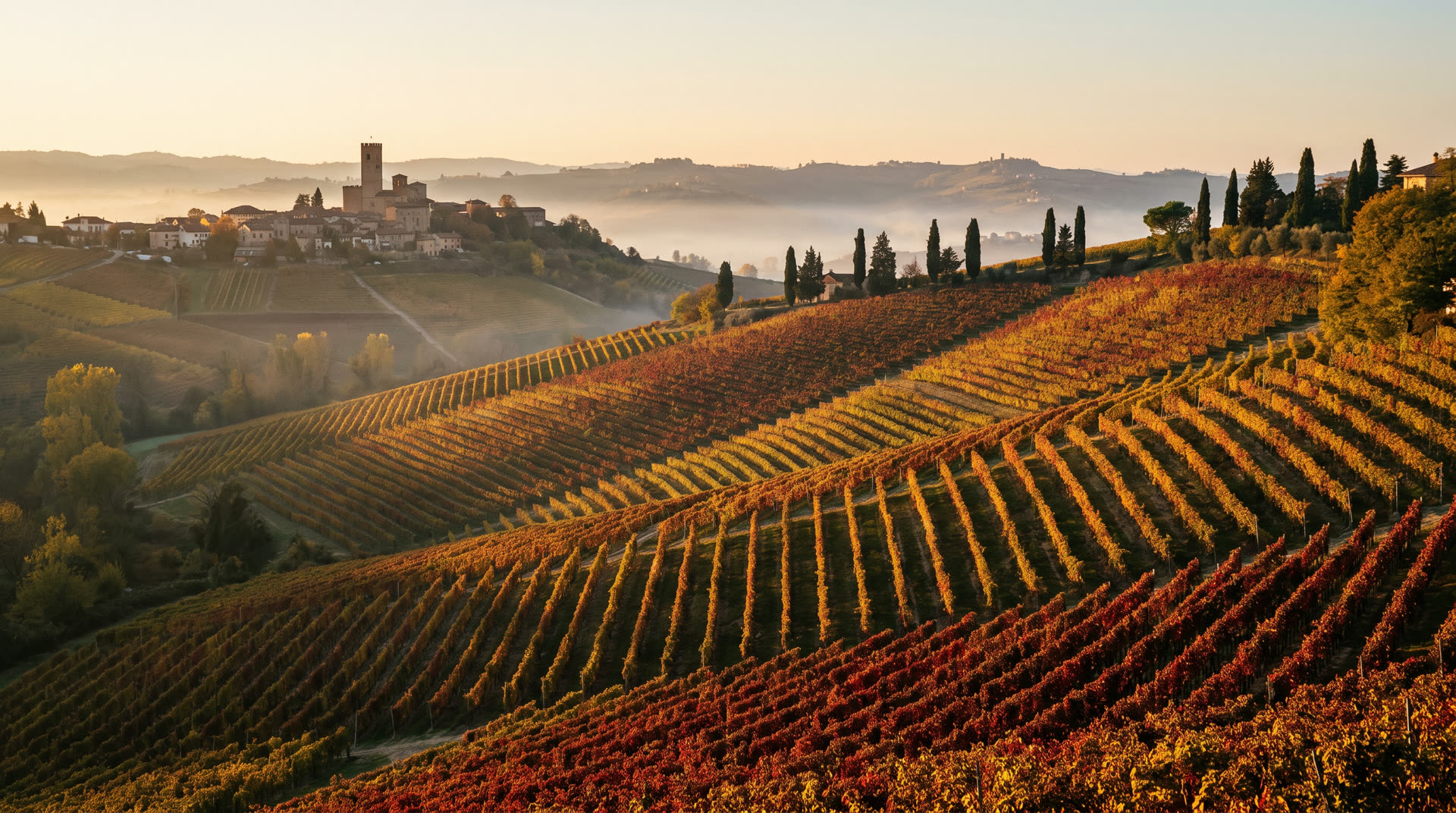
Autumn vineyards on the hills of the Langhe near Barbaresco, Piedmont, with a hilltop village in the distance

Piedmont · Nebbiolo · DOCG since 1980

The Queen of the Langhe, Cru by Cru

Barbaresco is one hillside kingdom split into four communes and sixty-six named vineyards. This guide maps the terrain, compares the major crus by style, names a benchmark producer for each commune, and explains exactly how Barbaresco differs from its neighbor Barolo.

First, the sibling rivalry

How Barbaresco differs from Barolo

Both are 100% Nebbiolo, both hold Italy's top DOCG rank, both were elevated on the very same day — July 1, 1980. But they are not interchangeable. Barbaresco's hills sit lower and closer to the moderating Tanaro river, so its Nebbiolo ripens earlier, its aging laws are shorter, and its wines generally show sooner and with more perfume than the more tannic, longer-aging Barolo to the southwest.

Terroir & climate

Barbaresco's four communes lie at lower elevation, closer to the Tanaro river, whose moderating influence and warmer mesoclimate push grapes to ripen earlier than in Barolo. Barolo's eleven communes climb higher into the hills and see two distinct soil families — the lighter Tortonian marls around La Morra and Barolo, and the denser, sandier Serravallian‑Helvetian soils around Serralunga and Monforte — giving Barolo a more varied geological signature than Barbaresco's comparatively unified Tortonian base.

Aging requirements

Barbaresco26 mo.min. 9 in wood
Barolo38 mo.min. 18 in wood
Barbaresco Riserva50 mo.
Barolo Riserva62 mo.

Barbaresco can reach the market roughly a year sooner than Barolo.

Scale of the zones

Barbaresco~730 ha4 communes · 66 MGAs
Barolo~2,000 ha11 communes · 181 MGAs

Barbaresco produces roughly a third of Barolo's annual bottle volume.

In the glass

Barbaresco is typically the more fragrant and finer-boned of the two — rose, red cherry and orange peel with silkier, earlier-resolving tannin. Barolo tends toward greater density, tar-and-truffle power and a longer, sterner tannic backbone. Drinking windows reflect this: Barbaresco is often approachable at 10–20 years (Riserva 15–30), while Barolo rewards 15–30 years and Riserva bottlings 25–40.

Sources: Barbaresco DOCG disciplinare, BigHammerWines, Wine with Seth.

The denomination

Four communes, one appellation

Barbaresco DOCG covers roughly 730 hectares on the eastern Langhe, immediately west of the Tanaro river and northeast of Alba. It spans four communes — Barbaresco itself, Neive, Treiso, and the small hamlet of San Rocco Seno d'Elvio (a frazione of Alba) — each with a distinct soil profile and stylistic signature. Hover or tap a commune below to see its character; click to jump to its full profile.

Tanaro River Alba Barbaresco village Neive Treiso San Rocco Seno d'Elvio N

Illustrative sketch map, not to survey scale — drawn to show relative position and adjacency of the four communes, not exact parcel boundaries.

Sixty-six MGAs, the ones that matter

Major crus compared by style

Since 2007, Barbaresco's most important vineyard sites have been officially recognized as MGAs (Menzioni Geografiche Aggiuntive) — Italy's answer to a French cru. Filter by commune to compare how each site tends to taste, and who bottles the benchmark version.

Commune by commune

Terroir, top sites & the producer to seek out

Each commune has its own map of key MGAs and its own reference producer — the estate whose wines most reliably show what that ground tastes like.

Commune 1 of 4

Barbaresco (the village)

The largest commune by registered area (about half the appellation) and the historic core of the denomination. Its ridge of calcareous, magnesium-rich marl running below the village — through Asili, Rabajà and Martinenga — is the closest thing Barbaresco has to a grand cru row: wines here are classically structured, perfumed rather than muscular, with the finest, most textbook tannin of the whole DOCG. Montestefano, further inland, breaks that mold with the commune's most Barolo-like density.

  • Soil: Calcareous blue-grey marl (Tortonian), high in magnesium and calcium
  • Signature crus: Asili, Rabajà, Martinenga, Montestefano, Pajè, Rio Sordo, Ovello, Pora, Roncagliette
  • House style: Elegant, floral, refined tannin — the appellation's reference point for finesse

Benchmark producer

Produttori del Barbaresco

Founded in 1958 by parish priest Don Fiorino Marengo with nineteen growers, this cooperative is the single best window into the commune's terroir: in strong vintages it bottles up to nine separate single-MGA Riservas — including Asili, Rabajà, Montestefano, Pajè, Pora, Ovello and Rio Sordo — plus a multi-MGA "Classico," all at prices well below their quality level.

Also watch for: Gaja (Roncagliette's Sorì San Lorenzo & Sorì Tildìn) and Marchesi di Gresy (the sole-owned Martinenga monopole).

Barbaresco village Asili Rabajà Martinenga Pajè Rio Sordo Montestefano Ovello Pora Roncagliette

Illustrative sketch — relative position of Barbaresco commune's best-known MGAs, not surveyed parcel lines.

Neive village Santo Stefano Gallina Serraboella Cottà Currà Basarin Bricco di Neive

Illustrative sketch — Santo Stefano and Gallina sit on the western border with Barbaresco commune; sandier sites lie further south toward Treiso.

Commune 2 of 4

Neive

The largest and geologically most varied of the three core communes — historically dubbed "the township of four wines" for its Barbera, Dolcetto, Moscato and Nebbiolo. Clay-rich soils along the western border with Barbaresco (Santo Stefano, Gallina) give Neive's most powerful, structured, tannic Barbarescos; sandier sites further south and the elevated ancient-sand sites near the village (Serraboella, Bricco di Neive) trade some power for lift and refinement.

  • Soil: Heterogeneous — clay-rich marl near Barbaresco, sandier Lequio/Sant'Agata formations further south
  • Signature crus: Santo Stefano, Gallina, Serraboella, Cottà, Currà, Basarin, Bordini, Bricco di Neive
  • House style: The most powerful, tannic and structured expressions of the appellation, with the longest aging potential

Benchmark producer

Bruno Giacosa

Born in Neive in 1929 and nicknamed "the Genius of Neive," Giacosa released the first formally declared single-vineyard Barbaresco in 1964, from Santo Stefano — a wine that set the standard for the entire appellation for five decades and remains the reference for what this commune can achieve.

Also watch for: Castello di Neive (Santo Stefano, Gallina), Sottimano (Cottà, Currà, Basarin), Piero Busso (Gallina), Paitin (Serraboella).

Commune 3 of 4

Treiso

The highest and coolest of Barbaresco's communes, once a mere frazione of Barbaresco itself. Elevation and ancient Lequio-formation soils give Treiso's wines a naturally leaner, more austere, high-toned register — the most fragrant and floral style in the appellation, built for lift rather than muscle. Pajoré is considered one of the five true "grand cru" sites of the entire denomination.

  • Soil: Higher elevation, ancient Lequio-formation marls, some clay increase versus Barbaresco village
  • Signature crus: Pajoré, Rizzi, Rombone, Bernardot, Bricco di Treiso, Nervo
  • House style: Fragrant, high-toned, floral and fine-boned — elevation over power

Benchmark producer

Rizzi

The Dellapiana family estate sits at the heart of the Rizzi cru — a large, multi-exposure vineyard that also lends its name to the winery — and produces a classical, traditional style Barbaresco alongside a celebrated bottling from the Pajoré grand cru.

Also watch for: Ca' del Baio, Sottimano (Pajoré), Fiorenzo Nada (Rombone), Pio Cesare.

Treiso village Pajoré Rizzi Bernardot Bricco di Treiso Rombone Nervo

Illustrative sketch — Pajoré sits toward the Neive/Barbaresco border; Rizzi and Nervo trend south toward San Rocco Seno d'Elvio.

toward Alba Rocche Massalupo Montersino Meruzzano

Illustrative sketch — only four MGAs sit fully within San Rocco, the smallest and lowest-lying of Barbaresco's communes.

Commune 4 of 4

San Rocco Seno d'Elvio

A small hamlet of the Alba comune rather than a full village, contributing only about 5% of the appellation's area. It sits lower and closer to Alba than the other three communes, without the Tanaro's cooling influence or Treiso's altitude — a combination that historically read as "lesser" but today, in a warming climate, gives some of Barbaresco's freshest, most immediately open and easy-drinking wines.

  • Soil: Sandy, lighter-bodied profile; lowest elevation of the four communes
  • Signature crus: Rocche Massalupo, Montersino, Meruzzano (the last two shared with Treiso)
  • House style: Lighter, fruitier, softer and more approachable — the earliest-drinking Barbarescos

Benchmark producer

Manuel Marinacci

Right on the border of Alba village and the Rizzi MGA, Marinacci's Rocche Massalupo bottling is the clearest expression of this small zone's fresher, easier-drinking character — a wine increasingly sought after as consumers gravitate toward a more open, early style of Barbaresco.

Also watch for: Albino Rocca (Montersino).